
Competency Development: The Foundation of Sustainable Organisational Performance
Written by: Shamsul Bahri Mohd Yusof (SBMY
Competency Development Is Not Just HR Talk
Competency Development is often treated as an HR initiative — a framework owned by HR, discussed during audits, and revisited during training planning. In reality, it is far more than that.
Competency Development is a strategic enabler of organisational performance.
One of the most common mistakes organisations make is delegating competency development entirely to HR, while expecting line managers and leaders to deliver results. When competencies are unclear, expectations vary from one manager to another, and performance standards become inconsistent across the organisation.
A well-designed competency framework provides clarity on what “good” looks like — not only for individual roles, but across functions and levels. It shapes how people are recruited, developed, assessed, and promoted, ensuring talent decisions are consistent, objective, and aligned with business direction.
Without a structured competency foundation, organisations risk fragmented training efforts, subjective performance assessments, and unclear expectations of what capability truly matters.
Why Competency Development Matters More Than Ever
Many organisations continue to invest heavily in training yet struggle to see sustained improvement in performance. The issue is rarely the lack of training. More often, it is the absence of a clear competency reference point.
Today, roles change faster than development cycles. Leadership expectations evolve more quickly. Compliance and governance requirements tighten. There is little room left for learning through trial and error.
Competency Development matters because it:
- Defines the knowledge, skills, experience, and behaviours required for success
- Establishes consistent performance expectations across roles and levels
- Provides a common language for talent and leadership decisions
- Ensures development efforts are intentional, not reactive
When competencies are clearly articulated, organisations are better equipped to plan their workforce, develop leaders, manage performance, and prepare successors with greater confidence and clarity.
Moving from Assumptions to Standards
In many organisations, “experience” is still used as a proxy for capability. Promotions, succession decisions, and development investments are often influenced by tenure, visibility, or past roles — even when performance evidence is mixed.
Competency Development replaces assumptions with standards.
It defines what good performance looks like by identifying:
- Required knowledge, skills, and experience
- The right attitudes and behaviours (as reflected in Irshad’s KESA Competency Model)
- Clear proficiency levels, from foundational to advanced
By setting role-specific expectations aligned with organisational goals, competency frameworks create a shared understanding of capability across the organisation.
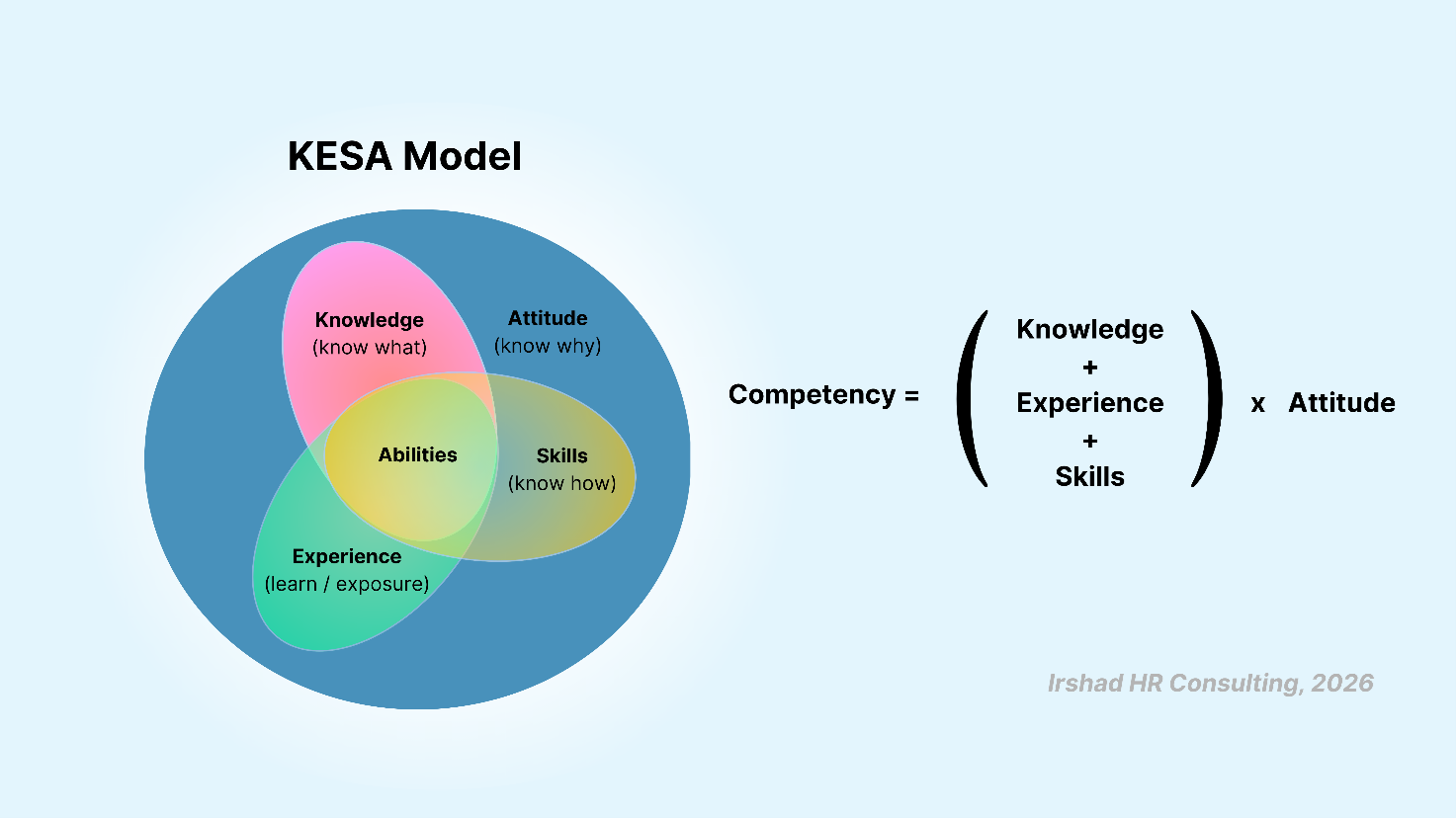
Without this foundation, HR and leadership decisions particularly in hiring, training, and performance evaluation tend to rely on subjective judgement. Competencies provide a measurable, observable reference point that strengthens fairness, consistency, and decision quality.
The Wider Impact of Competency Development Across HR Processes
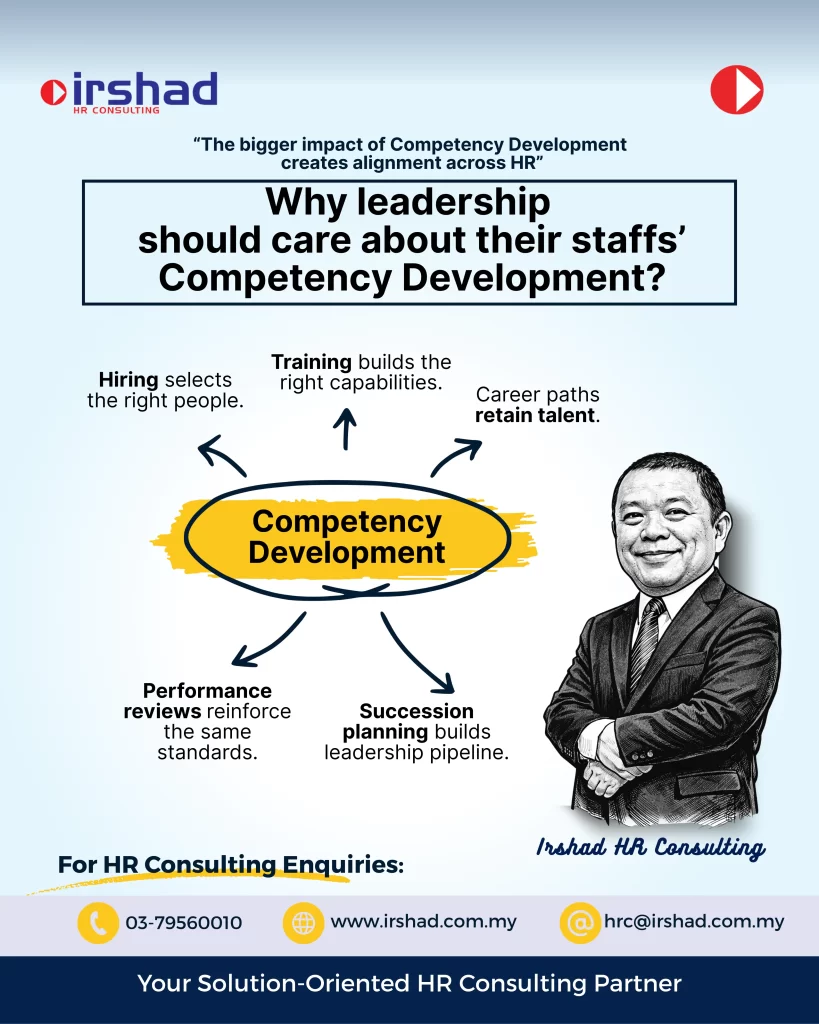
Competency Development acts as an organisation’s talent compass. Its impact goes far beyond Learning & Development.
- More Accurate Hiring
When competency profiles guide recruitment:
- Interviews become structured and evidence-based
- Behavioural indicators replace gut-feel judgements
- Job-candidate fit improves
Hiring decisions are no longer based on intuition alone, but on demonstrated capability.
- Fairer and More Consistent Performance Reviews
When performance is assessed against defined competencies:
- Expectations are clearer to employees
- Managers evaluate observable behaviour, not personal bias
- Feedback becomes specific and developmental
This strengthens trust in the performance management process.
- Clearer Succession Planning
Competency Development enables organisations to:
- Define future role requirements clearly
- Assess readiness objectively
- Distinguish between “ready now”, “ready soon”, and “development required”
Succession planning becomes data-driven rather than opinion-driven.
- Structured Career Path and Employee Development
Employees often ask, “What do I need to develop to move to the next level?”
Competency frameworks provide that clarity by:
- Making career paths transparent
- Highlighting clear development priorities
- Enabling employees to take ownership of their growth
This drives engagement, motivation, and retention.
Competency Development in Practice: From Capability Definition to Evidence-Based TNA Decisions
In practice, effective competency-based Training Needs Analysis (TNA) does not begin with training requests or annual learning calendars. It begins much earlier, ie with competency development.
Based on our experience conducting competency-based TNA across various organisations, effective capability development begins with competency identification and architecture development. Only when required and current competency levels are clearly defined does gap assessment provide meaningful insights to guide learning and development interventions..
These requirements are then structured into a competency architecture, comprising a competency model, role-specific competency profiles, and clearly defined proficiency levels. This architecture provides a shared reference point for what “good performance” looks like across the organisation.
Only when this foundation is in place does competency gap assessment become meaningful. By assessing the Current Competency Level (CCL) against the Required Competency Level (RCL), organisations gain clear, evidence-based insights into where capability gaps exist, how critical they are, and which roles or functions should be prioritised.
This diagnostic approach fundamentally changes how Training Needs Analysis is conducted. Instead of asking, “What training should we run this year?”, organisations are able to ask more strategic questions:
- What capabilities are required for this role today and in the near future?
- Where are the most critical gaps affecting performance and readiness?
- Which gaps require training, and which require other development interventions?
Figure below shows Irshad’s simplified process of Competency-Based Training Needs Analysis, showing the practice for how any decision to a Learning & Development Intervention comes to be:

As illustrated in Figure 3, competency-based TNA serves as a diagnostic engine that helps organisations determine the most appropriate development actions based on identified competency requirements and gaps. The resulting interventions may include structured learning programmes, coaching and mentoring, job rotation, or other non-training solutions, depending on the nature of the gap identified.
By anchoring TNA to competency development, organisations move away from ad-hoc training towards intentional capability building, ensuring that development investments are targeted, prioritised, and aligned with real performance requirements.
From Training Activities to Capability Building
Many organisations are not under-trained — they are over-trained in the wrong areas.
When development initiatives are guided by competencies:
- Learning objectives become clearer and more focused
- Development pathways become structured and progressive
- Outcomes are measured by capability improvement, not attendance
Over time, organisations move away from ad-hoc training towards intentional capability building, where people are developed in line with both current and future organisational needs.
Why Competency Development Must Come Before Training
Training without competency development often leads to:
- Misaligned programmes
- Low training impact
- Repeated training with minimal improvement
Irshad’s approach ensures that competency development comes first, followed by a structured Competency-Based TNA, and only then the design of learning interventions. This sequence builds capability — not just training activity.
Competency Development is not a standalone HR exercise. It is the backbone of effective talent management.
Partnering Organisations for Long-Term Capability Growth
Irshad HR Consulting is a Malaysian HR consulting firm with 38 years of experience supporting organisations across both private and public sectors. Over the years, we have partnered with organisations to design, validate, and implement competency development initiatives that strengthen talent systems and organisational performance.
Our experience consistently shows that organisations investing in structured competency development are better positioned to build a future-ready workforce — one that is aligned, capable, and resilient.
A Practitioner’s Reflection
In our work, organisations that treat competency frameworks as documents often struggle to see impact. Those that treat competencies as decision-making references build capability that lasts.
Competency clarity is not a one-off exercise. It is a long-term investment in organisational performance.
A Thought to Consider
For HR practitioners:
How clearly are competencies defined across your roles — and how consistently are they applied across HR processes?
For L&D professionals:
Are your development programmes driven by real capability requirements, or by training calendars?
For top management:
Do you have a clear view of the capabilities your organisation needs today? And those required to sustain performance in the future?